


E le loro infinite sfumature Alba
Scoprite il fascino delle Langhe città per città, dai loro castelli ai festival locali
Built on the right side of the Tanaro river, Alba gathers and controls the whole production and all the initiatives of this part of Piedmont.
It’s its interest and aspiration.
Also in the past centuries, as a “ligures” village, as a Roman “municipium”, and as a free Commune, this has always been its primary role.
During the feudal period not one lord could settle there stably enough to ensure the feud to his dynasty: the hundred red towers, built to magnify its medieval opulence, are a visible trace of this ever-changing history.
History
The first traces of people living on the left side of the Cherasca river, near the confluence with the Tanaro, are of the Neolithic period, between the sixth and the third millennium in prehistory.
In the following millenniums this population was included in the Liguri tribes.
The Roman conquest was slow and difficult, and completed around the year 173.
The town first entered history with the name of “Alba Pompeia”, and had a great economic and commercial development.
Publio Elvio Pertinace, famous roman genaral and emperor for a shot time, was born in Alba in 126.
With the decline of the Roman empire Alba knew a difficult period, made even more difficult because of the Barbarian invasions (Visigoths, Burgunds, Longobards, French, Saracins, Hungers).
In 967 Aleramo was given from the emperor Ottone I the rule of the Langhe: Alba knew then a period of stableness and an impressive urban development.
Between 1100 and 1500 the Commune tried to widen its territory, fighting with the town of Asti and being ruled by many different lords.
After having been ruled many times by the Gonzaga from Mantova and the Savoia, in 1628 it became a property of the Savoia royal family again, this time for good.
During World War II, Alba found itself at the center of war operations, and the whole town was given the Military Golden Medal thanks to its partisan activity.
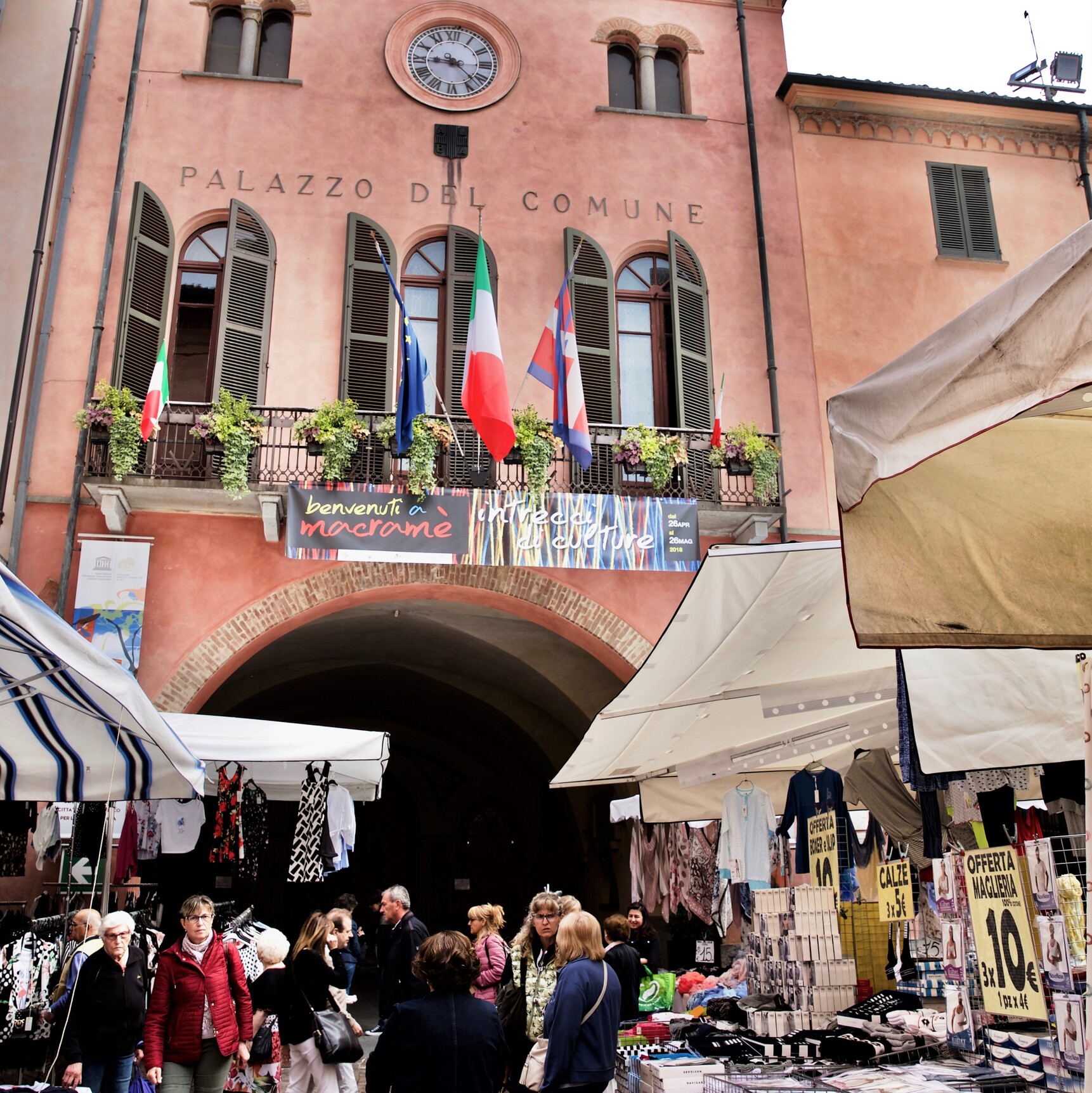
Alba is a lively town with many delicatessen shops, restaurants, bars and a variety of clothes’ shops; each Saturday morning there is the market and there are many events taking place throughout the year.
Originally Alba was known as the city of the 100 towers, most dating back to the 14th and 15th centuries, a fair amount of the towers still remains and are lit up at night, giving the town a romantic atmosphere.
Ferrero
Alba is also known for its chocolate, as Ferrero produces much of its chocolate here; perhaps a dream for any chocoholic as the smell of chocolate is literally in the air.
The Ferrero production facility is based on the outskirts of Alba and the company is one of the largest employers in the region; not only through direct employment, but also because it purchases the hazelnuts grown in the area.
The typical Ferrero-taste is due to the excellent quality of the locally produced hazelnuts which are called the “Tonda Gentile del Piemonte IGP”.
The nuts are lightly toasted to give them their distinctive flavour; Ferrero is regarded highly in the region as Michele Ferrero was a local entrepreneur that made Ferrero big, but always remained true to his roots.
The company always took very good care of its employees and their families in the form of honest wages, good pensions and help to widows and orphans.
Ferrero died in 2015, aged 89 and the central square of Alba was then renamed after him to honour his life and legacy.
Alba’s history and cultural heritage
Alba's origins date from before the Roman civilization when it was inhabited by Celtic and Ligurian tribes; funnily enough, Alba was also the birth town of one of Britain’s earliest governors: Publius Helvius Pertinax (125–203AD) who governed Britain from 185 to187AD.
The current city is built on the Roman remains of the ancient Alba Pompeia, probably founded while the Romans were constructing a road from Aquae Statiellae, the current Acqui Terme, to Augusta Taurinorum modern-dayTurin.
In the 11th century Alba became a city-state and member of the Lombard League which subsequently formed the battle ground for many fights, amongst which were the fights between the Montferrat and Visconti families; it was conquered by the House of Gonzaga, twice by the Savoy and later France and Spain battled over its possession.
In 1631 the Treaty of Cherasco was signed, this put an end to the battles and Alba became part of the Savoy territory; their reign can still be recognised by the red and white of the Savoy flag in the city’s emblem.
Historical buildings that are worth a visit in Alba include the Palazzo Comunale (13th century) housing a Nativity scene dating from 1501 by Macrino d'Alba, the Bishop's Palace, and the Romanesque Cathedral of San Lorenzo (12th century); they are all on the central Piazza Duomo.
The San Lorenzo is probably built on holy edifices dating from the Roman age and was restructured in several stages, the church is well known for its wood-carved chorus made in 1512 by Bernardino Fossati, and its stunning blue ceilings.
The Gothic church of San Domenico (13th -14th century) is the most beautiful church in town and interestingly enough used as a stable during the Napoleonic Wars.
A nice excursion is to visit Alba’s ‘sotterranei’ (underground Alba) which are the underground Roman ruins and remains that have been excavated underneath the ‘new’ town.
You will find the entrance at Piazza Risorgimento in front of the Tourist Office where you can book a guided tour; it is an interesting way to learn more about Alba and its history.
Festival
Alba can be visited year-round, as its streets and squares are always lively and there is always something to do.
In the mornings, people gather in the bars and squares to have a cup of coffee or late breakfast and round five in the afternoon everyone comes out to have a ‘gelato’ (ice-cream).
On Saturday mornings everyone gathers for the large market where you can find everything, from cheap clothes to expensive delicatessen.
Alba is home to many events that make the city worth a visit year-round: in March Alba hosts the annual International Film Festival which combined with the Bra short film festival offers an interesting offer for film-fans from Italy and abroad, in April the wine festival “Vinum” brings life to Alba’s pretty squares: it is a great time to wander through town and taste a glass here and there.
In September the town’s medieval times are brought back to life as the people gather to re-enact historical events dressed in period costumes and artefacts; the focal event is the ‘palio’ (the donkey race), which is a historical race to celebrate and remember the ancient fights between Asti and Alba; the race takes place in fact both in the cities of Alba and Asti.
October and November are probably the busiest months with the International Truffle Fair: during this period the scent of truffles’ fills the air and the restaurants are fully packed with foodies from all over the world; there is a special truffle exposition and Alba’s streets are lined with stalls offering everything a ‘gourmand’ could wish for.
On the third Saturday in October the ‘Baccanale dei Borghi’ takes place: a fantastic display of folklore where all ‘borghi’ (city quarters) present themselves with their traditionally cooked dishes, games and folk-clothes: it is a festival that is both extremely funny and very cosy; games include riding a fake donkey, throwing darts at sausages, and fishing for wine bottles.
I spent one of the funniest evenings of my life there, especially the fake donkey ride that almost had me on the floor with laughter.
The truffle festival, which lasts for 2 months, is the one that attracts the most tourists, and from furthest away; the unique and distinctive taste and fragrance of the Alba truffle is one you will probably either adore or passionately dislike.
Either way, visiting Alba around this time is still a feast for the senses, as the town is at its liveliest and everyone comes out to eat, drink and party.
Origin of the truffle festival
The first Alba Truffle Festival took place in 1929: in the early days it was Giacomo Morra who recognised the potential of the truffle, and since then he and his family have been promoting the Alba truffle.
In the 1950’s, he introduced the tradition of giving a piece of truffle to a famous guest: amongst the celebrities have been presidents Truman, Eisenhower, Kennedy and Reagan, statesmen like Winston Churchill and Michel Gorbachev, and celebrities such as Marilyn Monroe, Alfred Hitchcock, Sophia Loren and Alain Delon.
Morra’s shop can still be found at Piazza Pertinace in Alba, in the restored Casa Torre dating back to the 12th century.
The shop sells excellent products and has many interesting historical pictures that give a good insight into the lives of the ‘trifulau’ (the truffle hunter).
The festival is traditionally held in October: this is at the height of the white truffle harvesting season, when prices are highest and competition intense.
Alba truffles sell for thousands of Euros per kilogram and the prices paid for the largest tubers are astronomical: the record price paid for a single white truffle was set in December 2007, when a truffle weighing 1.5 kilogram was auctioned simultaneously in Alba, Florence, Macau and Hong Kong.
The truffle was found by Luciano Savini and his dog Rocco and was the largest found in decades.
A Macau casino owner paid $330,000 for the truffle.
Though seemingly decadent, the wonderful thing about the Truffle hunt is that all the proceeds are donated to charity.
What a beautiful tradition to keep!
Food & Drinks
It almost goes without saying that Alba offers everything a food lover could wish for: excellent delicatessen shops, wonderful wine bars where you can taste local wines accompanied with small typical Piemontese appetisers and some of the best restaurants in the region.
The land of foodies
For an intimate wine-tasting go to Vincafè or to Voglia di Vino, both in Alba’s pedestrian shopping centre, or to the Eno Club at Piazza Savona.
Vincafè has through the years been my favourite because, if it is very busy you can always go downstairs and have a drink in the cosy cantina like cellar.
The choice of wines is large and the appetisers plentiful: a delightful way to end a day of sightseeing in town.
Even more exceptional though, are Alba’s many excellent restaurants.
Just out of curiosity check the Michelin Guide website and you may be surprised to discover that the small town of Alba and its direct surroundings, has more Michelin recommended restaurants than the large city of Turin! This is indicative of how special this area is.
The most prestigious of them all is restaurant Piazza Duomo led by the renowned chef Enrico Crippa.
It not only has three Michelin stars (one of the few in Italy), but has also achieved a15th place ranking in the best restaurants of the world.
Enrico Crippa worked in Marchesi’s restaurant in Kobe, Japan, where he became an expert in Japanese flavours.
His signature dish is Salad 41, named after the number of leaves, flowers and herbs it contains, most coming from his own garden.
Be aware of the long waiting list, in particular in autumn when Alba is packed with visitors for the Truffle Fair.
On top of this, Alba also has one-star restaurants like Locanda del Pilone and Larossa, and many more in the surrounding villages.
The Langhe really is a foodies’ paradise: even the inhabitants themselves say: ‘You cannot find a bad restaurant in our region’.
The competition therefore varies between very good, exceptional and unforgettable.
The Barbera wine
The Barbera is the typical wine of this area,its grape is the third most planted grape in Italy and dates from the fifteenth century.
Despite this impressive statistic, the wine was until recently, rarely drunk outside of Italy.
Maybe because the italians were just saving the best for themselves! The Barbera vines originate from the Piedmont and are still grown in many places in the Langhe.
Like for the Dolcetto, also these vines have traditionally been planted on sites not suitable for Nebbiolo grapes, and hence they had a lower standing.
The man that first put these wines on the global map, was the late Giacomo Bologna of the Braida estate (near Asti), whose Bricco dell'Uccellone was the first Barbera that was internationally marketed.
The wine became successful with its unique formula for choosing quality over quantity (i.e.high yields) and letting the wine age in French oak barrels.
The Barbera is now one of the most popular wines of the Piemonte and is a serious contender to Barolo and Barbaresco.
Generally, it is named after the town where it originates, hence the Barbera d’Alba, Barbera d’Asti and Barbera del Monferrato.
Whilst the wine is often very dark in colour, it is quite light in taste with flavours of cherry, strawberry, and raspberry.
The Barbera d’Alba tends to have a deeper colour and more fruit, while the Barbera d’Asti is often brighter in colour and more elegant on the palate.
The Piemontese drink Barbera daily, whereas Barolo and Barbaresco are saved for special occasions.
The white truffle of Alba
The famous white truffles of Alba were first mentioned in the writings of Theophrastus in the fourth century BC.
At the time their origin was a mystery to many, leading to the hypotheses that they were created by thunder and lightning, or were the children of God.
It was not until 1788 that the truffle got its official scientific name from a Turin physician and naturalist named Vittorio Pico, hence the name: Tuber Magnatum Pico.
The origin of the word truffle appears to lie in the Latin term “tuber”, meaning "lump", which early on became “tufer” and then “tartufo” (truffle) ;the truffle has not always been popular.
From Roman times until the Renaissance they were hardly used; around 1800 the truffle quickly became more popular, first with popes, then with noblemen and around 1900 to a wider audience.
Now truffles are held in high esteem in French, northern Italian and Istrian cooking, as well as in international haute cuisine.
Truffles belong to the mushroom family and flourish throughout autumn, winter and spring.
There are nine varieties of truffle, but the Langhe is home to the most delicate and precious three types of white truffle.
The Alba truffle is found in the whole Langhe and symbiotically grows with oak, hazel, poplar and beech.
It can grow to about 12 centimetres in diameter and 500 grams in weight, most of them are much smaller though.
The flesh is pale cream or brown with white marbling.
Contrary to the legend, truffles can be cultivated.
As early as 1808, the Frenchman Joseph Talon collected some acorns at the foot of oak trees known to host truffles, and sowed them elsewhere; the experiment was successful.
In 1847, Auguste Rousseau planted 7 hectares of oak trees following the same method and obtained a large harvest of truffles, receiving an award for his effort at the 1855 World Fair in Paris.
Finding truffles is an art in itself, and a ‘trifulau’ would never share his secrets with anyone on where he finds his truffles and how.
All truffle hunters have their own spots, their trained dog, and share the habit of hunting very early in the morning.
Some truffle hunters now offer the opportunity to join a truffle hunt to see how it’s done, that gives a wonderful insight into this ancient tradition.
Truffles are found by their smell: they produce a scent resembling boar’s hormones: this is why, traditionally, sows were used to find them.
However, as they often ate the truffles, they were replaced by dogs; good dogs are worth a fortune and their training is a true profession: there is even a dog university in the village of Roddi.
Truffle dogs are kept inside a cage or pen to protect their nose, too much exposure to other smells is considered detrimental for their truffle finding abilities; they are trained year-round.
Truffle is best eaten within days of finding.
Because of their high price and their pungent taste, they are used sparingly.
They are traditionally eaten with very simple dishes such as an omelette or with buttered ‘tajarin’ pasta.
When ordered in a restaurant, the waiter will shave the truffle freshly on your dish with a dedicated truffle slicer.
Black truffles are served year-round in the region.
In autumn, when the white truffles appear on the menu, the prices shoot up, but it really is worth it for an unforgettable experience.